
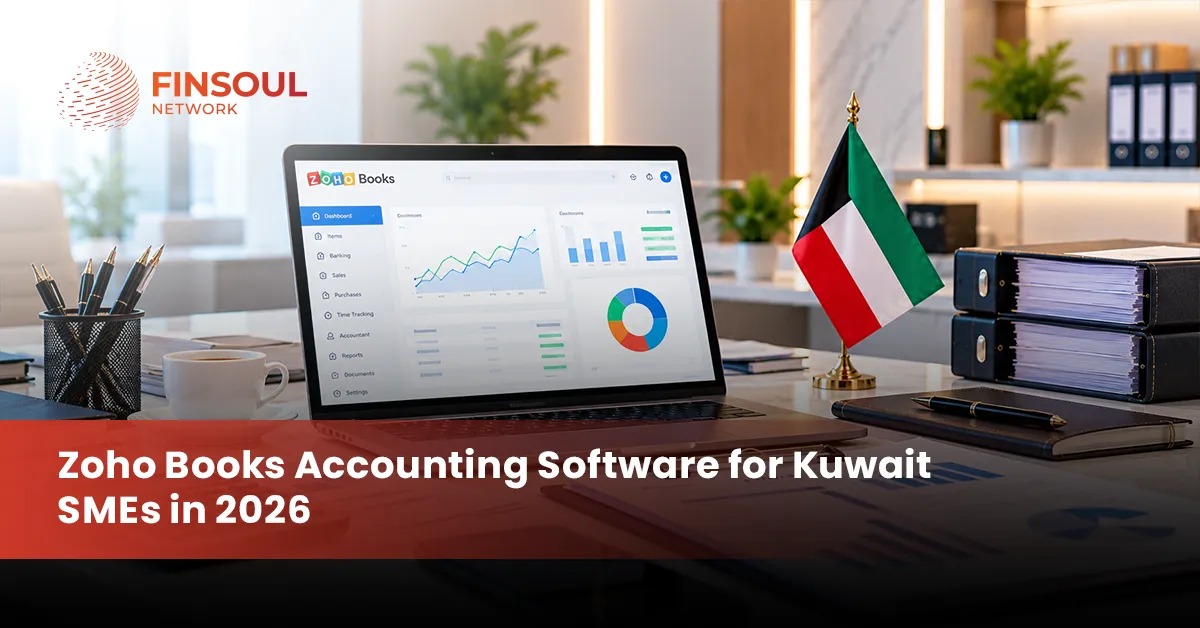
For Kuwait SMEs, choosing the right accounting platform can make day-to-day financial management easier without introducing unnecessary complexity. Zoho Books Accounting Software provides tools for invoicing, expenses, banking, financial reporting, inventory, and multi-currency transactions, making it relevant to businesses that want to move away from spreadsheets and manual bookkeeping. Zoho currently offers a Kuwait-specific edition with several plans designed for different business sizes and accounting requirements.
In 2026, businesses should assess more than the subscription price. The right accounting system should support accurate records, useful reports, efficient transaction processing, and appropriate access for business owners and accountants. It should also fit the company’s operations and Kuwait’s current tax and financial environment.
What Are Zoho Books?
Zoho Books is a cloud-based accounting platform that allows businesses to manage financial transactions, customers, suppliers, expenses, invoices, banking and reports from one system. It can be accessed through web and mobile applications, allowing business owners and finance teams to review records without relying on a single office computer.
The platform covers basic bookkeeping as well as more advanced accounting functions. Depending on the selected plan, businesses can manage vendor bills, purchase orders, inventory, projects, budgets, fixed assets, custom workflows, and advanced analytics.
For an SME, this means accounting activities can be brought into a single system rather than maintained through separate spreadsheets, invoice templates, and manually prepared reports.
Why Do Kuwait SMEs Need Cloud Accounting in 2026?
Small and medium-sized businesses often have limited finance teams. As transaction volumes increase, manually recording sales, expenses, and bank transactions can take considerable time and can make financial reporting more difficult. Cloud accounting can help businesses:
- Record transactions in one central system
- Issue and track customer invoices
- Monitor outstanding receivables
- Record supplier bills and expenses
- Reconcile bank transactions
- Track inventory
- Prepare financial reports
- Give accountants controlled access to financial information
- Manage transactions involving different currencies
For businesses that already outsource bookkeeping or accounting, cloud access can also make it easier for an external finance team to work with current records.
Businesses looking for wider financial support can also explore accounting and finance services from Finsoul Network Kuwait.
Key Features of Zoho Books for Kuwait SMEs
Invoicing and Receivables
Zoho Books allows businesses to create invoices and quotes, send payment reminders, manage recurring invoices, and monitor receivables. The Kuwait edition also supports online payment options and customer portals, subject to the applicable plan and payment setup.
This can be useful for professional service firms, consultants, traders and other SMEs that issue invoices regularly and need visibility over unpaid amounts.
Expenses and Payables
Businesses can record expenses, manage vendors and, on relevant plans, manage vendor bills and payments. Recurring expenses, purchase orders and approval functions are available at different subscription levels.
Keeping these transactions within the accounting system helps finance teams connect purchases and expenses with the wider financial records.
General Ledger and Chart of Accounts
A properly organised ledger is central to reliable financial reporting. General ledger Zoho Books functionality works through the platform’s chart of accounts, journals, and accounting modules. Zoho Books provides account categories for assets, liabilities, equity, income and expenses, while businesses can create additional accounts where required. For a Kuwait SME, the chart of accounts should be configured according to the business model and reviewed by the responsible accountant rather than simply using default accounts without assessment.
Bank Reconciliation
Bank reconciliation allows businesses to compare recorded accounting transactions with bank activity. Zoho Books supports bank and credit card accounts, statement imports, and reconciliation functions.
This is particularly useful for businesses with frequent payments, collections, and supplier transactions, as unreconciled items can otherwise remain unnoticed.
Zoho Books Inventory Management
Zoho Books inventory functions allow businesses to manage items, monitor stock and set reorder points on plans that include the relevant inventory features. Higher plans provide more advanced inventory controls, including warehouses, barcode functions, serial numbers, and batch tracking.
This makes the platform more relevant to Kuwait trading, wholesale, retail, and distribution businesses than a basic invoicing-only system.
Multi-Currency Transactions
Kuwait-based businesses may deal with overseas customers and suppliers. Professional and higher plans support multi-currency transactions, with exchange-rate functions available within the platform. This can be useful for importers, exporters, consultants serving overseas clients, and businesses purchasing goods or services internationally.
Financial Reporting
Zoho Books provides financial reports covering areas such as profit and loss, balance sheet, cash flow, sales, receivables, and expenses. The platform states that it provides more than 70 detailed financial reports.
The value of these reports depends on the quality of the underlying records. Accounting software can generate reports, but businesses still need appropriate accounting procedures and review.
Zoho Books Pricing for Kuwait SMEs in 2026
Zoho’s current Kuwait pricing page lists six plans. The displayed prices are in US dollars and are stated by Zoho to exclude local taxes.
| Plan | Monthly Price | Annual Billing Price | Main Position |
| Free | $0 | $0 | Micro businesses and basic accounting |
| Standard | $18 | $15/month | Core accounting and transactions |
| Professional | $30 | $25/month | Projects, purchases, and inventory |
| Premium | $42 | $35/month | Automation and additional controls |
| Elite | $99 | $85/month | Advanced inventory |
| Ultimate | $249 | $200/month | Advanced analytics |
The annual-billing figures represent the monthly equivalent when billed annually. Zoho also offers additional paid add-ons for functions such as extra users, document scans, locations, and expense claims. Businesses should therefore calculate the expected total subscription cost rather than choosing a plan solely from its headline price.
Which Zoho Books Plan Is Right for a Kuwait SME?
The free plan may be appropriate for a very small operation with limited accounting requirements. The standard plan adds functions such as bank feeds, recurring expenses, custom reports, and transaction-period locking. The professional plan becomes more relevant when a business needs vendor bills, purchase orders, inventory, projects, or multi-currency transactions. Premium adds further customisation, budgets, fixed assets and cash-flow forecasting. Elite is aimed at businesses with more demanding inventory operations, while Ultimate adds advanced analytics and larger data capabilities. The choice should be based on:
- Number of users
- Transaction volume
- Inventory requirements
- Multi-currency needs
- Reporting requirements
- Approval processes
- Number of business locations
- Need for advanced analytics
Zoho Books Accounting Software and Kuwait Tax Considerations
Businesses should distinguish between using accounting software and meeting their tax obligations. Kuwait’s Ministry of Finance maintains the Kuwait Income Tax Decree No. 3 of 1955 and its amendments. The Ministry’s tax services also cover tax registration and domestic minimum top-up tax registration for applicable entities. The Ministry of Finance’s published tax law states a 15% tax rate on net taxable income under the amended income tax provisions for entities covered by the law.
Kuwait had not implemented VAT as of 2026, so businesses should not configure a standard 5% Kuwait VAT charge simply because VAT applies elsewhere in the GCC. Current international government guidance also confirms that Kuwait has no VAT or sales tax at present.
However, tax treatment depends on the entity, ownership, activity, and applicable legislation. Businesses should confirm their position with a qualified Kuwaiti tax professional and refer to the Kuwait Ministry of Finance for official tax information.
Can Zoho Books Integrate with CRM and Customer Service Systems?
Accounting software becomes more useful when financial information can connect with sales and customer-service processes.
Zoho Books and Zoho CRM
Zoho provides an official Zoho CRM integration for its Kuwait edition. Contacts, vendors, and items can be synchronised, while businesses can create and manage transactions across the connected systems.
For example, a sales team can manage customer information in CRM while the finance team handles invoices and receivables in Zoho Books.
Freshdesk Integration with Zoho Accounting
Businesses searching for Freshdesk integration with Zoho Accounting should distinguish between a direct native accounting integration and an integration workflow using another platform. Zoho’s official documentation confirms integrations between Freshdesk and Zoho CRM through Zoho Flow, while Zoho Books has its own documented CRM integration.
Therefore, a Kuwait SME should verify the exact workflow it needs before assuming that every Freshdesk and accounting function synchronises directly.
Freshdesk Integration with Zoho Books
The same consideration applies to Freshdesk integration with Zoho Books. If a business wants customer-service information to trigger accounting actions, it may require an integration platform, API connection, or other connector rather than assuming that the two applications have the same native integration.
Zoho Books provides API capabilities, which can support application-to-application connections where the required workflow is technically feasible.
Freshdesk Zoho CRM Integration
A Freshdesk Zoho CRM integration can be useful where customer support and sales teams need shared customer information. Freshdesk documents its Zoho CRM integration, while Zoho Flow provides workflows between Freshdesk and Zoho CRM.
For an SME, connecting customer service and CRM data can reduce duplicate customer records and give sales teams better visibility into support activity. The accounting connection should then be designed separately around the company’s billing and finance processes.
How to Set Up Zoho Books for a Kuwait SME
A sensible implementation should start with the company’s accounting structure rather than simply opening an account and entering transactions.
1. Create the Organisation
Set up the company profile and relevant business information.
2. Configure Currency and Financial Settings
Set the appropriate base currency and accounting preferences.
3. Build the Chart of Accounts
Review assets, liabilities, equity, income and expense accounts and add accounts required by the business.
4. Add Customers and Vendors
Import existing customer and supplier records where appropriate.
5. Add Products and Services
Set up products, services, prices, and inventory information where relevant.
6. Configure Invoices and Payment Terms
Set invoice formats, payment terms, reminders, and relevant payment options.
7. Connect or Import Banking Data
Connect supported bank feeds or import statements where direct connectivity is unavailable.
8. Enter Opening Balances
Opening balances should be checked carefully before live transactions begin.
9. Add Users and Accountant Access
Zoho Books allows businesses to provide accountant access and manage user permissions.
10. Test Reports and Reconciliation
Before relying on the system for monthly reporting, test transactions, reconciliation, and financial reports.
For businesses that need assistance with maintaining records after implementation, Bookkeeping Services in Kuwait can be considered as part of the wider finance function.
Zoho Books vs Excel for Kuwait SMEs
| Area | Zoho Books | Excel |
| Invoicing | Built into the accounting system | Usually manual |
| Bank reconciliation | Dedicated accounting function | Requires manual matching |
| Financial reports | Generated from recorded transactions | Often requires formulas |
| Inventory | Available on relevant plans | Requires spreadsheet controls |
| Multi-user access | User permissions are available. | File-based collaboration |
| Automation | Recurring and workflow functions | Limited |
| Accountant access | Supported | Usually requires file sharing |
| Audit trail and transaction control | Accounting-focused controls | Depends on spreadsheet design |
Excel can still be useful for analysis and supplementary calculations, but businesses with growing transaction volumes may find a dedicated accounting platform easier to manage.
Benefits and Limitations for Kuwait SMEs
Benefits
The main advantages include:
- Cloud access
- Centralised financial records
- Invoicing and receivables management
- Expense and supplier management
- Bank reconciliation
- Inventory functions
- Multi-currency accounting
- Financial reporting
- Accountant collaboration
- Different plans for different business requirements
Limitations
Zoho Books is not automatically the right choice for every business. Some advanced functions are restricted to higher plans, while complex manufacturing, warehouse or enterprise operations may require additional systems. Banking and third-party integrations should also be checked before implementation because availability can depend on the specific service, country, plan and technical requirements.
Most importantly, software does not replace accounting judgement. Businesses remain responsible for maintaining appropriate records and obtaining professional advice where tax, reporting, or statutory requirements require specialist interpretation.
When Should a Kuwait SME Choose Zoho Books accounting software?
Zoho Books can be a practical option for a Kuwait SME that needs cloud accounting, regular invoicing, expense management, bank reconciliation, and financial reporting without adopting a full ERP system.
It may be particularly suitable for:
- Start-ups
- Professional service businesses
- Consultants
- Small trading companies
- Retail businesses
- E-commerce companies
- Growing SMEs
- Businesses with moderate inventory requirements
Businesses with complex manufacturing, extensive warehouse operations or highly specialised enterprise requirements should compare the platform with ERP and industry-specific accounting solutions before making a decision.
Conclusion
For many Kuwait SMEs, Zoho Books Accounting Software offers a practical way to bring invoicing, expenses, banking, inventory, and financial reporting into one cloud-based accounting environment. Its different subscription levels also allow businesses to select functionality according to their transaction volume and operational requirements.
The important point is to assess the system against the actual accounting structure of the business. A small service company may need only core accounting, while a trading business may require inventory and multi-currency features. Businesses with complex operations should assess integration, reporting, and ERP requirements before committing to a plan.
For implementation, bookkeeping support, or wider accounting assistance, Finsoul Network Kuwait can help businesses assess their finance processes and determine how accounting technology can fit into their existing operations.
FAQs
What is Zoho Books accounting software?
Zoho Books is cloud-based accounting software that helps businesses manage invoicing, expenses, bank transactions, financial reporting, tax records and other day-to-day accounting activities.
Is Zoho Books available in Kuwait?
Yes. Zoho provides a dedicated Kuwait edition with local pricing and features for businesses operating in the country.
Does Zoho Books support Kuwaiti dinar?
Businesses should configure the appropriate base currency for their organisation. The platform also supports multi-currency transactions on relevant plans.
Does Kuwait have VAT in 2026?
Kuwait has not implemented VAT as of 2026. Businesses should still monitor official announcements because tax policy can change.
Can Zoho Books manage inventory?
Yes. Inventory functions are available across the relevant plans, with advanced warehouse, batch, serial-number, and other inventory controls available on higher plans.
Can an accountant access Zoho Books?
Yes. Zoho Books provides accountant access and collaboration features, allowing finance professionals to work with business records remotely.