
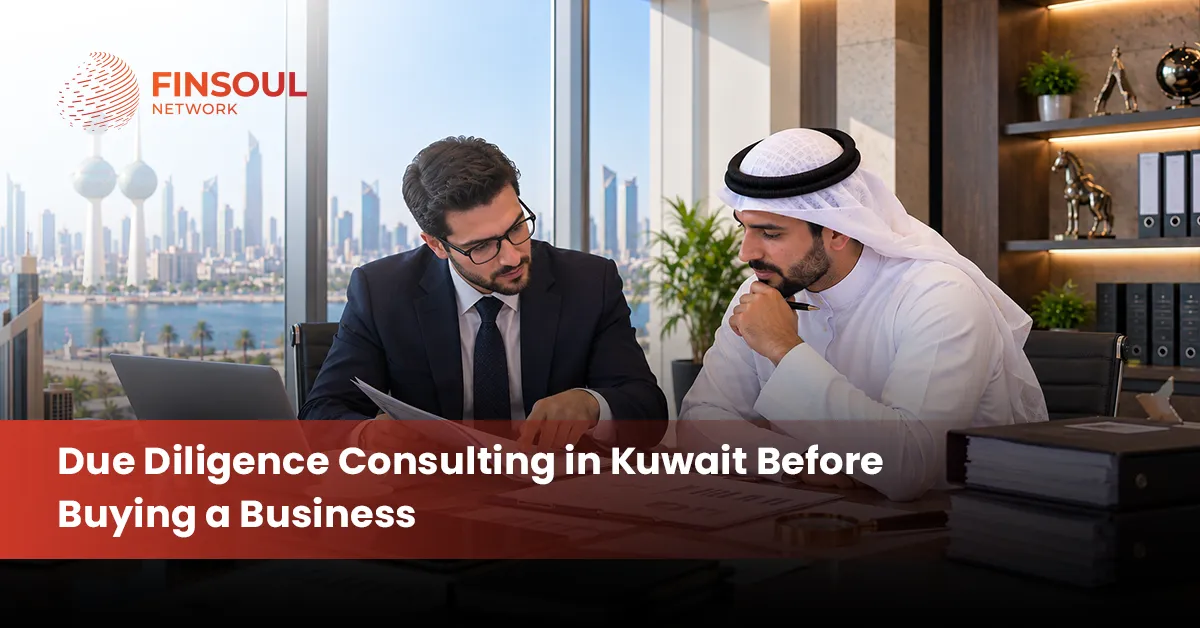
Buying an existing business in Kuwait can provide a faster route to market, an established customer base, existing licences and an operating team. However, the apparent value of a business can change significantly once its financial records, contracts, liabilities and regulatory position are examined. Due diligence consulting gives prospective buyers an organised way to verify what they are actually acquiring before they commit capital. Finsoul Network Kuwait helps businesses approach this process with structured analysis focused on the risks and obligations associated with an acquisition.
Why Is Due Diligence Important Before Buying a Business?
An acquisition should never rely only on the seller’s asking price, management explanations or headline revenue figures. A business may have unpaid obligations, weak cash flow, restrictive contracts, licensing issues or disputes that do not appear in an initial sales presentation.
Due diligence consulting allows the buyer to compare information supplied by the seller with supporting records. It also helps identify risks that could affect the purchase price, transaction structure or decision to proceed.
For buyers in Kuwait, the review should consider corporate records, commercial licences, ownership information, financial position, tax obligations, employment matters, contracts and regulatory requirements. The Ministry of Commerce and Industry provides electronic services relating to commercial registration, licences and other corporate records, making official verification an important part of the acquisition process.
What Areas Should Buyers Review Before an Acquisition?
A thorough acquisition review should cover the areas that could materially affect the business after completion.
Financial Performance
Buyers should examine several years of financial statements, management accounts, bank records, revenue trends, expenses, receivables, payables and working capital. The objective is to establish whether reported profits reflect sustainable business performance.
Financial due diligence should also test whether revenue has been recognised appropriately, whether expenses have been recorded completely and whether unusual transactions have affected reported results.
Existing Liabilities
A buyer should identify bank facilities, shareholder loans, supplier balances, lease commitments, guarantees and other financial obligations. Undisclosed liabilities can increase the effective cost of an acquisition and may require specific protections in the purchase agreement.
Tax and Statutory Obligations
Tax records should be reviewed alongside financial information. Depending on the ownership and activities of the target, the review may need to consider corporate tax exposure, tax filings, withholding obligations and historical compliance.
Kuwait’s Ministry of Finance continues to identify income tax from foreign companies within its public budget reporting, demonstrating why tax status should form part of an acquisition review where relevant. Finsoul Network Kuwait can help buyers identify tax-related information that requires further examination before the transaction moves forward.
Corporate Registration and Licences
The buyer should verify the target’s legal form, commercial registration, business activities, licences and registered information. Kuwait’s Ministry of Commerce and Industry provides commercial registry services and corporate procedures covering matters such as licences, partner changes and amendments to company information. The buyer should also establish whether the target is operating within the activities authorised by its registered licences. Any discrepancy between actual operations and registered activities may require resolution before or after completion.
Ownership and Beneficial Ownership
The buyer needs to establish who legally owns and controls the target and whether the information provided by the seller matches official records.
Kuwait has requirements concerning actual beneficial ownership, including maintaining accurate and updated beneficial-owner information. The Ministry of Commerce and Industry states that ownership transfers involving a change in beneficial ownership require a declaration concerning the change and relevant updated information. This makes ownership verification an important part of an acquisition review, particularly where the target has multiple shareholders or indirect ownership arrangements.
Contracts and Commitments
Material customer, supplier, distribution, lease, financing, employment and technology agreements should be examined. The buyer should identify termination rights, change-of-control provisions, exclusivity clauses, minimum commitments and unusual commercial terms. A business can appear commercially attractive until its most important agreement is found to expire shortly after completion. Contract review should therefore focus not only on what the agreement says today but also on what could happen after ownership changes.
Employees and Labour Obligations
Payroll records, employment contracts, accrued benefits and outstanding employee claims can create post-acquisition costs. Buyers should understand the workforce structure and determine whether there are unpaid salaries, disputes or other obligations that could affect the transaction.
Assets and Inventory
Physical and intangible assets should be checked against accounting records. The review may include property, equipment, vehicles, inventory, software, intellectual property and other operating resources. Buyers should also confirm ownership and identify assets subject to security interests, financing arrangements or other restrictions.
Customers and Suppliers
Customer concentration can create a major commercial risk. If a significant share of revenue depends on a small number of customers, the buyer should assess the stability of those relationships. Supplier concentration, dependency on specific distributors and the availability of alternatives should also be considered. A business that relies heavily on one supplier may face operational difficulties if commercial terms change after the acquisition.
How Does Financial Analysis Support an Acquisition Decision?
The purpose of financial analysis is not simply to confirm whether the target made a profit. It should establish the quality, sustainability and reliability of the earnings being purchased. Buyers should compare reported revenue with bank receipts, contracts, invoices and customer records where appropriate. They should review gross margins, operating expenses, working capital movements and recurring versus one-off income. Cash flow deserves particular attention because a profitable business can still face liquidity pressure.
The review should also identify unusual related-party transactions, large receivables, slow-moving inventory, significant provisions and expenses that the buyer may inherit after completion. These findings can influence the purchase price, transaction structure and protections required in the acquisition agreement. Finsoul Network Kuwait can assist buyers in organising these findings so that significant financial issues receive appropriate attention during negotiations.
What Does Legal Review Cover?
A legal review examines whether the business has the rights and permissions required to operate and whether existing obligations could affect the buyer after completion. The review may include incorporation documents, constitutional documents, shareholder information, commercial registrations, licences, material contracts, leases, financing documents, litigation records and intellectual property rights.
The buyer should pay particular attention to contracts that can be terminated or renegotiated following a change in ownership. It is also important to identify restrictions on transferring contracts, assets or licences. Legal review should work alongside the financial review rather than operate separately. A contractual obligation may have a direct financial impact, while an ownership or licensing issue may affect whether the business can continue operating as expected.
How Does Commercial Review Assess Business Viability?
Commercial due diligence focuses on the market position and operating prospects of the target. It helps buyers assess whether historical performance is likely to continue after the acquisition. The review can consider the target’s customer base, competitors, pricing, market demand, sales pipeline, supplier relationships and dependence on key individuals. It can also test the assumptions behind the seller’s forecasts.
For example, projected growth may depend on a major customer renewal, a new licence, a planned product launch or an expansion that has not yet been approved. These assumptions should be verified rather than accepted at face value. Commercial analysis is particularly useful when the asking price reflects anticipated future growth rather than only historical performance.
What Red Flags Should Buyers Watch For?
Certain warning signs deserve further investigation before an acquisition proceeds.
Inconsistent Financial Information
Differences between financial statements, tax records, bank activity and management reports can indicate weak controls or incomplete information.
Unexplained Liabilities
Large unpaid balances, shareholder loans, guarantees or contingent obligations can materially change the economics of the transaction.
Regulatory Gaps
Expired licences, unapproved activities or incomplete corporate records can create operational and regulatory risks.
Customer Concentration
Heavy reliance on one customer or a small group of customers can make future revenue less predictable.
Legal Disputes
Current or threatened litigation can result in financial costs, management distraction and reputational consequences.
Unusual Related-Party Transactions
Transactions with shareholders, directors or connected businesses should be understood and supported by appropriate documentation.
How Is the Due Diligence Assessment Usually Conducted?
The process normally begins with an information request based on the scope of the proposed acquisition. The seller provides financial, corporate, legal, commercial and operational documents through an organised data room or another secure document-sharing process. The due diligence assessment then verifies important information, compares records, identifies inconsistencies and evaluates the potential impact of each material issue. Questions are raised with the seller or management where documents do not provide a clear explanation.
The findings are then classified according to their likely impact. High-risk matters may require price adjustments, specific contractual warranties, indemnities, conditions precedent or other transaction protections. This approach allows the buyer to move from document collection to practical decision-making rather than simply accumulating information.
What Documents Are Commonly Required?
The exact list depends on the nature and size of the target, but buyers commonly request:
- Commercial registration and licence documents
- Constitutional and shareholder documents
- Beneficial ownership information
- Historical financial statements and management accounts
- Bank statements and financing records
- Tax filings and correspondence
- Customer and supplier contracts
- Lease and property documents
- Employee records and payroll information
- Details of litigation and disputes
- Asset registers and inventory records
- Insurance policies
- Intellectual property documentation
- Material regulatory correspondence
Finsoul Network Kuwait can help buyers organise the information request around the specific characteristics of the target business.
What Happens When Problems Are Identified?
Finding risks does not automatically mean that a buyer should abandon the transaction. The appropriate response depends on the seriousness, cost and remediability of the issue. Some matters can be resolved before completion. Others may justify a reduction in the purchase price or additional contractual protection. A serious undisclosed liability, ownership problem or regulatory obstacle may require the transaction to be restructured or stopped altogether. Due diligence consulting therefore supports negotiation as well as risk identification. It gives the buyer evidence for discussions with the seller instead of relying on assumptions.
Why Work With a Professional Due Diligence Provider?
Buying a business involves reviewing information across multiple disciplines. A professional team can bring together financial, tax, corporate and commercial analysis and organise the findings into a decision-focused report. Due diligence services can be particularly useful when the buyer does not have an internal team with sufficient time or specialist knowledge to examine the target independently. An external review can also provide a more objective assessment of information supplied by the seller.
Finsoul Network Kuwait supports buyers with structured reviews designed around the nature of the proposed acquisition. The work can focus on the areas that matter most to the transaction, identify material risks and present findings in a clear format for decision-making.
How Can Buyers Prepare for a Better Review?
Buyers can improve the process by defining the transaction objectives before requesting documents. They should know what they are buying, which risks they are unwilling to accept and which areas require deeper verification. It is also important to begin the review early. Waiting until the final stages of negotiations can leave too little time to investigate concerns or obtain additional evidence.
Buyers should maintain a clear record of questions, responses and outstanding documents. This creates an audit trail and helps ensure that significant issues do not disappear during negotiations. Finsoul Network Kuwait can provide a structured approach that helps keep the review focused on material acquisition risks rather than unnecessary information gathering.
Conclusion: Make an Informed Business Acquisition Decision
An acquisition in Kuwait should be based on verified information rather than assumptions about a target’s profitability, ownership or future prospects. A well-structured review can reveal financial, legal, tax, commercial and operational risks before they become the buyer’s responsibility.
Due diligence consulting gives buyers a clearer basis for assessing the target, negotiating transaction terms and deciding whether the proposed investment makes commercial sense. With careful preparation and independent analysis, buyers can approach an acquisition with greater confidence and a better understanding of the obligations they are taking on. Finsoul Network Kuwait can support businesses that want a structured and evidence-based review before committing to a business acquisition in Kuwait.
FAQs:
What is commercial due diligence?
Commercial due diligence is a structured review of a business’s market position, customers, competitors, revenue sources, products, suppliers and future growth prospects. It helps buyers determine whether the business has sustainable commercial potential before completing an acquisition.
Why should a buyer conduct due diligence before purchasing a business in Kuwait?
Due diligence helps a buyer verify the target company’s financial position, ownership, licences, contracts, liabilities, tax obligations and operational condition. It can uncover issues that may affect the purchase price or decision to proceed.
What financial information should be reviewed before buying a business?
Buyers should review financial statements, management accounts, bank statements, revenue records, receivables, payables, working capital, loans and other financial obligations. This helps determine whether the reported financial performance reflects the actual condition of the business.
How can buyers identify hidden liabilities during an acquisition?
Hidden liabilities can be identified by reviewing financial records, contracts, financing arrangements, tax documents, employee obligations, litigation records and outstanding supplier or creditor balances. Comparing information across different records can also reveal inconsistencies.
Should licences and commercial registrations be checked before buying a company in Kuwait?
Yes. Buyers should verify the company’s commercial registration, business activities, licences and other official records. They should also confirm that the company’s actual activities match its authorised activities and that required licences remain valid.