
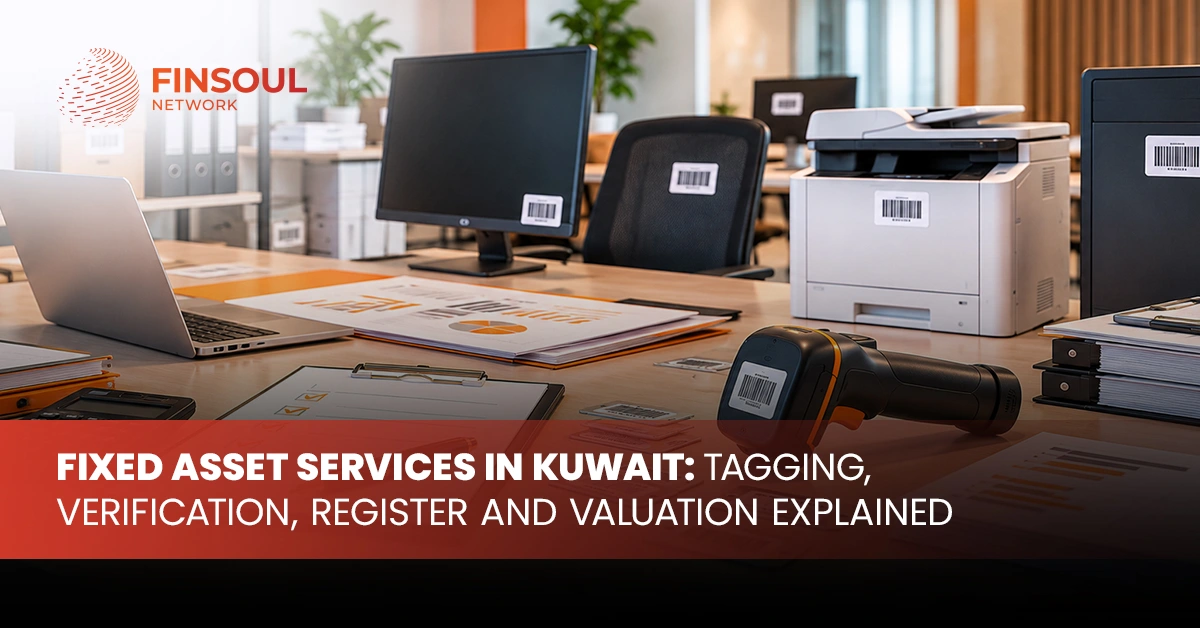
Fixed assets such as buildings, machinery, vehicles, computers and office equipment represent significant investments for businesses in Kuwait. Companies need accurate records of these assets to monitor their location, calculate depreciation, prepare financial statements and support audit procedures. Accounting Services Kuwait discusses how businesses can manage their assets through proper identification, physical verification, register maintenance and valuation.
Effective asset management connects the physical items a business owns with the information recorded in its accounting system. If equipment has been moved, disposed of or incorrectly recorded, the difference may remain unnoticed until an audit or financial review. This guide explains the four main areas of fixed asset management, the records businesses should maintain and the factors to consider when selecting suitable accounting systems.
What Are Fixed Asset Services in Kuwait?
Fixed asset services cover the identification, recording, inspection, reconciliation and financial measurement of a business’s long-term tangible assets. These assets are generally held for use in operations, administration or the supply of goods and services rather than for immediate resale. Common examples include:
- Buildings, warehouses and office premises.
- Production machinery and industrial equipment.
- Company cars, trucks and other business vehicles.
- Computers, servers, printers and office furniture.
- Equipment used in construction, healthcare and logistics.
- Eligible leasehold improvements.
Under IAS 16, Property, Plant and Equipment, an item is generally recognised as an asset when future economic benefits are probable and its cost can be measured reliably. The standard also addresses initial measurement, depreciation, subsequent measurement and derecognition. Businesses should consult the official IAS 16 guidance from the IFRS Foundation when reviewing the applicable accounting treatment. The precise requirements depend on the asset, the entity’s accounting framework and its circumstances. Businesses should not assume that every purchase of equipment qualifies for capitalisation; their accounting policies and applicable reporting requirements must be considered.
Fixed Asset Tagging Services in Kuwait
What Is Fixed Asset Tagging?
Fixed asset tagging assigns a unique identification number or label to an individual asset. The number connects the physical item to its entry in the asset register, allowing staff to identify it during inspections, transfers and audits.
For example, a company operating several offices may have hundreds of laptops, monitors and printers. A tag assigned to each item helps distinguish equipment with similar descriptions and records its location, assigned department and responsible employee.
A useful tagging system should provide:
- A unique asset identification number.
- A readable label attached to the item where practical.
- A corresponding entry in the asset register.
- Recorded location and departmental responsibility.
- A process for replacing damaged labels and updating asset movements.
Types of Fixed Asset Tags
Businesses can choose a tagging method based on the number of assets, working conditions and available technology.
| Tag type | How it works | Suitable use |
| Barcode | Staff scan a printed code using a compatible scanner. | Office equipment, furniture and general inventory. |
| QR code | A mobile device or scanner reads a two-dimensional code. | Assets requiring quick access to identification records. |
| RFID | Radio-frequency technology identifies compatible tags using a reader. | Large asset populations or environments requiring faster scanning. |
| Numbered label | A printed or engraved number identifies the item. | Small businesses with straightforward tracking requirements. |
The label itself does not replace accounting records. Each identifier must link to a reliable register, and businesses should test whether tags remain readable in their operating environment.
Fixed Asset Tagging Process
The process normally begins with reviewing existing asset records and agreeing on an identification format. Staff then inspect the items, assign unique numbers, attach labels and record relevant details. Differences between the physical items and existing records should be documented for review.
Assets that are difficult to tag, such as buildings or certain installed machinery, may require alternative identification methods. The business should maintain enough information to identify each item without relying solely on a physical label.
Fixed Asset Verification Services in Kuwait
What Is Physical Fixed Asset Verification?
Physical verification confirms whether assets recorded in the accounting system actually exist, where they are located and what condition they are in. It can also identify items that are present but missing from the register.
This work is particularly useful for businesses operating from multiple branches, warehouses, construction sites or industrial facilities. Changes in staff, equipment transfers and incomplete disposal records can create differences between physical assets and accounting records.
Fixed Asset Verification Process
A typical verification exercise follows these steps:
- Review existing records: Obtain the asset register, location details, acquisition information and previous verification findings.
- Plan the inspection: Divide assets by site, department or category and agree on access arrangements.
- Inspect physical assets: Locate each item and confirm its identification number, description, and condition.
- Record discrepancies: Document missing items, unrecorded equipment, incorrect locations, duplicate entries and damaged assets.
- Reconcile the results: Compare inspection findings with the register and accounting records.
- Prepare findings: Provide a list of differences requiring investigation, correction or management approval.
For example, a company may have a printer recorded at its head office even though it was transferred to another branch. Verification identifies the location difference so the register can be updated with supporting evidence.
Identifying Missing, Damaged and Unrecorded Assets
Verification should distinguish between different types of discrepancies. An asset not found during an initial visit may have been transferred, placed in storage or temporarily unavailable. Staff should investigate before treating it as lost.
Damaged equipment may require a condition assessment and a separate accounting review. Unrecorded assets should be checked against purchase invoices, delivery notes and other evidence before their records are created. Duplicate entries should also be investigated to avoid overstating the number or value of assets.
Reconciling Physical Assets with Accounting Records
The final reconciliation connects inspection findings with the asset register and general ledger. Differences may relate to acquisition costs, asset classifications, locations, disposals or accumulated depreciation.
Corrections should follow the company’s approval procedures and be supported by suitable documentation. Physical verification does not, by itself, establish the appropriate accounting value of an asset. Valuation and impairment assessments may be required separately.
Fixed Asset Register Preparation and Maintenance
What Is a Fixed Asset Register?
A fixed asset register is a central record of a business’s capitalised assets and their relevant accounting and identification details. It helps finance teams track asset movements, calculate depreciation and reconcile asset balances with the general ledger.
A register may be maintained in a spreadsheet or accounting application, depending on the size and complexity of the business. The important consideration is whether the records are complete, accurate, accessible to authorised staff and regularly updated.
Key Information Included in a Fixed Asset Register
| Record field | Purpose |
| Asset ID and description | Identifies the individual item. |
| Asset category | Groups items for reporting and accounting. |
| Acquisition date and cost | Records when the asset was acquired and its recognised cost. |
| Supplier and invoice reference | Supports the recorded acquisition. |
| Location and department | Shows where the asset is held and who is responsible for it. |
| Useful life and residual value | Supports depreciation calculations. |
| Depreciation method | Records the method applied under the accounting policy. |
| Accumulated depreciation | Shows depreciation recognised to date. |
| Carrying amount | Shows the recorded value after relevant depreciation and impairment. |
| Transfer and disposal history | Documents changes during the asset’s life. |
The fields required will depend on the company’s reporting needs. Maintaining acquisition evidence, approval records and a clear history of changes makes the register easier to review.
Preparing and Updating the Register
When creating a register from existing records, the business should collect available invoices, purchase records, previous schedules and physical inspection results. Each asset should receive a unique identifier, and missing information should be flagged rather than estimated without evidence.
The register must also reflect subsequent changes. New acquisitions should be recorded, transfers should update location details, and disposals should be processed under the applicable accounting policy. Regular reconciliation helps identify errors before they affect financial reporting.
Businesses using fixed asset register QuickBooks workflows should check which fixed asset details their particular QuickBooks product and version can maintain directly. Depending on the setup, an external register or dedicated asset application may be needed to manage physical tags, verification results and detailed asset histories. The accounting records and supporting register should still be reconciled.
Fixed Asset Valuation Services in Kuwait
What Is Fixed Asset Valuation?
Fixed asset valuation determines the appropriate monetary value of an asset for a particular purpose, such as financial reporting, a business transaction or management review. The method depends on the asset type, the reason for valuation and the applicable accounting requirements.
Book value and market value are not interchangeable. Book value generally refers to the amount recorded after applicable accumulated depreciation and impairment. Market value concerns what an asset might be worth in a market transaction under the relevant assumptions.
Common Fixed Asset Valuation Methods
Three commonly used approaches are:
- Cost approach: Considers the cost of replacing an asset with one providing similar service potential, with appropriate adjustments for depreciation, physical deterioration and obsolescence.
- Market approach: Uses relevant market evidence from comparable assets and adjusts for differences in age, condition, specification and location.
- Income approach: Estimates value using relevant future economic benefits or cash flows where this method is appropriate to the asset and valuation purpose.
The suitability of each method depends on available evidence. A specialised machine with few comparable sales may require a different approach from a standard commercial vehicle.
Factors Affecting Fixed Asset Valuation
Valuation may be affected by the asset’s age, physical condition, remaining useful life, technical obsolescence, maintenance history, capacity and market demand. Location and the cost of transporting or installing equipment may also matter, depending on the valuation basis.
Businesses should establish why the valuation is required before selecting a method. An insurance assessment, a transaction valuation and a financial reporting revaluation may have different objectives and assumptions.
Book Value, Fair Value and Depreciation
Depreciation allocates an asset’s depreciable amount over its useful life. Under IAS 16, depreciation begins when the asset is available for use, and the method should reflect the expected pattern in which its economic benefits are consumed. The standard recognises methods such as straight-line, diminishing balance and units of production where appropriate. Useful life and residual value require review at least at each financial year-end.
For example, a business purchases machinery for KWD 20,000, estimates a residual value of KWD 2,000 and expects a useful life of six years. Under the straight-line method, annual depreciation would be KWD 3,000, assuming the asset is available for use for a full year and no other adjustments apply.
The calculation is:
(KWD 20,000 − KWD 2,000) ÷ 6 = KWD 3,000 per year
This is an illustrative accounting calculation, not a prescribed Kuwait tax depreciation rate. The actual treatment must follow the entity’s applicable accounting framework and circumstances.
Businesses considering fixed asset depreciation software for small business should look for functions that support acquisition costs, useful lives, residual values, depreciation methods, disposal records and reporting. Software calculations still need appropriate review and should follow the company’s accounting policies.
Documents Required for Fixed Asset Services
The documents required depend on the scope of the work. Businesses should prepare the following where available:
- Existing fixed asset register and general ledger balances.
- Purchase invoices, contracts and acquisition records.
- Asset descriptions, serial numbers and location details.
- Previous depreciation schedules and valuation reports.
- Records of transfers, disposals, repairs and major improvements.
- Relevant accounting policies and financial reporting information.
Missing documents should be identified early. Where records are incomplete, the business may need further inspection, supplier evidence or management confirmation before finalising the register or valuation.
Cost of Fixed Asset Services in Kuwait
The cost depends on the volume of assets, number of locations, accessibility of equipment and condition of existing records. A project involving a single office with a reliable register will generally require less work than one covering several warehouses with incomplete documentation.
| Cost factor | How it affects the work |
| Number of assets | More items require more identification and inspection time. |
| Number of locations | Multiple sites increase travel and coordination requirements. |
| Tagging requirements | Label type, installation and scanning needs affect the scope. |
| Record quality | Incomplete or conflicting records require additional investigation. |
| Valuation scope | Asset complexity and the required valuation basis affect professional input. |
Businesses should request a quotation that identifies the work included, deliverables, assumptions and any additional charges. A clear scope makes proposals easier to compare and helps avoid confusion over whether tagging, verification, register preparation and valuation are all included.
Conclusion
Accurate asset records help businesses in Kuwait maintain reliable accounts, monitor their property, and make informed financial decisions. From asset tagging and physical verification to register maintenance and valuation, fixed asset services support better control over business assets and financial reporting. Businesses that need assistance with these activities can contact Finsoul Network Kuwait to discuss their fixed asset requirements and the support available for their records and reporting needs.
Frequently Asked Questions
What is included in fixed asset services?
Depending on the agreed scope, the work may include asset tagging, physical verification, register preparation, reconciliation, depreciation review and valuation. Businesses should confirm which activities and reports are included before appointing a service provider.
What is a fixed asset inventory system?
A fixed asset inventory system helps businesses record, identify and track assets such as machinery, vehicles, computers and office equipment. It can include asset details, locations, identification tags and current status.
What is the difference between fixed asset verification and valuation?
Verification establishes whether assets exist, where they are located and what condition they are in. Valuation determines their monetary value for a defined purpose. The two activities can support each other, but one does not replace the other.
How often should fixed assets be verified?
The frequency depends on the size of the asset population, risk, movement and internal control procedures. Businesses may schedule periodic inspections and perform additional checks when assets are transferred, disposed of or reported missing.
Can software replace a fixed asset register?
Software can maintain asset records and automate certain calculations, but it does not remove the need for accurate source documents, physical checks, authorised updates and accounting review. The system must suit the business’s reporting and tracking requirements.